Selling a car in metro Atlanta: what the emissions rule asks of you
If you sell a gasoline car or light truck of a tested model year inside the 13 metro Atlanta testing counties, to a buyer who will register it there, Georgia's emissions program says the car needs a current passing inspection at the time of sale. Fulton and DeKalb are on that list. Below: which model years and fuels the rule reaches, how long a pass stays good after a sale, where to test and what it costs, and your choices when the car fails.
Sources re-checked .
Short answer
Only for a tested car. When a seller in one of the 13 metro Atlanta testing counties sells a gasoline car or light truck of a tested model year (2002 to 2023 for 2026 registration) to a buyer who will register it there, the car needs a current passing emissions test at the time of sale. A pass stays valid for 12 months, and the buyer can register on it.
Georgia's Clean Air Force: before you test; Georgia's Clean Air Force: used vehicle sales
The 13 counties and the cars that must test
Georgia's vehicle emissions program, better known as Georgia's Clean Air Force, is overseen by the Environmental Protection Division. It covers 13 metro Atlanta counties: Cherokee, Clayton, Cobb, Coweta, DeKalb, Douglas, Fayette, Forsyth, Fulton, Gwinnett, Henry, Paulding and Rockdale. A car registered in any other Georgia county does not need the test to register. The Department of Revenue lists an emission inspection certificate, if applicable, among the papers a buyer brings to the county tag office.
Inside those counties the test applies to gasoline cars and light-duty trucks with a gross vehicle weight rating of 8,500 pounds or less. The covered model years shift from one registration year to the next:
- 2026 registration: model years 2002 to 2023 must test. Model year 2024 and newer, and 2001 and older, are exempt.
- 2027 registration: model years 2003 to 2024 must test, and 2025 and newer are exempt.
The model year is the one the VIN shows. Diesels, motorcycles, RVs and motor homes do not test, and neither do vehicles over 8,500 pounds. A vehicle that runs only on natural gas, propane, battery electricity or hydrogen is exempt too. Hybrids, flex-fuel and bi-fuel cars are tested, because the program tests any vehicle that can burn gasoline. A Senior Exemption depends on the owner: the primary registered owner must be 65 or older, and a new application is due each year.
Source: Georgia's Clean Air Force: before you test; Georgia's Clean Air Force: exempt vehicles; Georgia's Clean Air Force: senior exemptions; Georgia's Clean Air Force: 2027 registration insert (PDF); Georgia EPD: vehicle emissions inspection program; Georgia DOR: title and register a vehicle bought in a casual sale.
What Georgia asks of you when you sell
The program's motorist FAQ says that when a used car will be registered in a covered county, "sellers located within the 13-county testing area must ensure the vehicle has a passing Georgia vehicle emissions inspection at the time of sale." The rule behind it, Georgia DNR rule 391-3-20-.18, ties the duty to where the car will be registered after the purchase. The seller flyer applies it to private parties, dealers and auctioneers.
The program's used-sale page adds the limit that decides many cases: "For a violation to be issued, both the seller and buyer must be located within the 13-county testing area at the time of sale." A buyer who gets a car with no passing test from a seller in the area can file the program's Used Vehicle Sale Complaint Form.
One thing you do not owe the buyer is a paper copy. The inspection report is on record electronically at the tag office. You can view a summary of a car's most recent results by entering its VIN on the program's VIR lookup page. Run that lookup before you list the car, so you know what the last test showed.
Source: Georgia's Clean Air Force: before you test; Georgia's Clean Air Force: used vehicle sales; Georgia's Clean Air Force: Seller Beware flyer (PDF); Georgia's Clean Air Force: VIR lookup; Ga. Comp. R. & Regs. 391-3-20-.18, sale of vehicles.
As-is, parts-only and salvage sales
Writing as-is on the bill of sale does not lift the duty. The seller flyer says a car sold as-is still needs a current passing report when the seller and the buyer are both in the 13-county area.
The exception is a car that is leaving the road. The same flyer says vehicles sold as parts only or salvage, with a title identified that way with the Department of Revenue's Motor Vehicle Division, "are not subject to the vehicle emissions law and it is the seller's responsibility to ensure the vehicle is not driven away from the sale." The rule itself sets two conditions for a sale for parts or salvage: the car is towed or hauled rather than driven on the streets, and the seller writes the purpose of the sale on the bill of sale.
The program pages do not address a sale to a buyer whose plans for the car you do not know. If your car would not pass and the buyer has not said it is buying for parts or salvage, ask before pickup. If the answer leaves you unsure, call the program at 1-800-449-2471. The scrap and junk routes are on selling a junk car in Atlanta.
Source: Georgia's Clean Air Force: Seller Beware flyer (PDF); Ga. Comp. R. & Regs. 391-3-20-.18, sale of vehicles; Georgia's Clean Air Force: waivers, exemptions and extensions.
How long a passing test stays good after a sale
A pass is valid for 12 months or one registration renewal, by the same owner. When someone buys a used car with a valid passing report, the previous owner's report can be used for the buyer's first registration, and for the buyer's next renewal too if it is still within 12 months. Only the most recent report is considered, so a newer failed test replaces an older pass. Within 12 months, a car may be sold several times on the same valid report.
Example, using only those rules: a car passes on March 10, 2026, and you sell it on October 1, 2026. The buyer can register it on your report, because the report is less than 12 months old. If the buyer's renewal falls after March 10, 2027, the car needs a new test first.
For a sale, test when you list the car, so the pass is still current when the buyer registers. A test from another state does not count in Georgia.
Source: Georgia's Clean Air Force: before you test; Georgia's Clean Air Force: Who Gets Tested When (PDF).
Finding a station and what the test costs
The program's testing-locations finder searches for stations near you or lists every station in a county. You do not have to test in the county where the car is registered. EPD puts the program at nearly 700 testing stations.
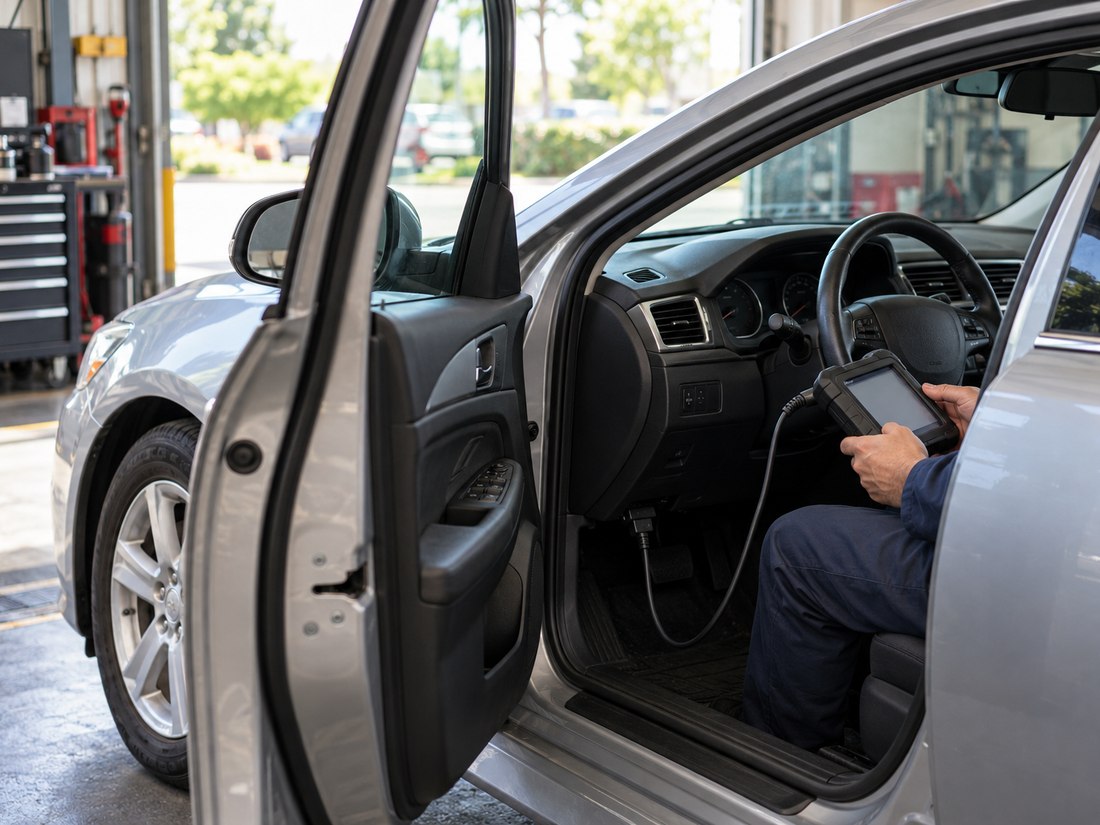
As of October 2026, the program says a test costs up to $25, and each station posts its fee on its official sign. The test has two parts: an onboard diagnostics (OBD) check of the emissions controls and a visual check of the catalytic converter for tampering or removal. If the check-engine light is on, the inspector must still test the car, but the program says it likely will not pass. A loose fuel cap can turn that light on, so tighten it first.
The program's customer service centers handle waivers and exemptions, not tests. Two of them are GCAF Central, the Clayton County center, at 445 Atlanta South Parkway, Suite 150, Atlanta, GA 30349, and the DeKalb center at 2260 Northlake Parkway, Suite 204, Tucker, GA 30084. Some metro tag offices offer waiver services too; ask yours first.
Source: Georgia's Clean Air Force: testing locations; Georgia's Clean Air Force: before you test; Georgia's Clean Air Force: 2027 registration insert (PDF); Georgia EPD: vehicle emissions inspection program; Georgia's Clean Air Force: customer service centers.
If the car fails: retest, waiver, or sell it as it stands
A car that fails has to be repaired and retested. You get one free retest at the original station within 30 calendar days of the first test, counting the day of that test. No retest happens until the repairs are done and your repair technician has filled in the Emissions Repair Form the inspector gave you.
If it fails again, a Repair Waiver may let the owner register for that year. As of October 2026, the waiver page sets the 2026 registration minimum at $1,176 spent on emissions-related repairs. The retest must show improvement in every area that failed, and the car must still pass the areas it passed. Estimates do not count, and if you do the work yourself only the parts count. "Repair Waivers are not renewable or transferable", so a waiver does not pass to the next owner. Your county tag office may also have a non-renewable 30-day registration extension under O.C.G.A. 40-2-20.
If the repair bill is more than you want to spend, selling the car as it stands is the other path. The partner buyer says non-running cars and cars missing parts can still get an offer, and it pays for the pickup. Check the as-is and parts rules above first, and see how the offer works for the pickup, the inspection and the check.
Source: Georgia's Clean Air Force: after you test; Georgia's Clean Air Force: repair waivers; The buyer: selling and free pickup.
Two questions Atlanta sellers ask about the test
Do I need a new emissions test to sell my car in Atlanta?
Not if the car already has a current pass. A pass is valid for 12 months, and the buyer can register on your report inside that window, says Georgia's Clean Air Force. If the last test failed or is over 12 months old, a seller in the 13 counties needs a new pass before selling a car of a tested model year to a buyer who will register there.
Does an electric car or a diesel need an emissions test in Georgia?
No. The program exempts diesels and vehicles that run only on battery electricity, natural gas, propane or hydrogen. A hybrid is different: it burns gasoline, so it is tested like any gas car registered in the 13 counties, and so are flex-fuel and bi-fuel vehicles. See the list of exempt vehicles.
Once the emissions question is settled
The title, the bill of sale and the plate come next, on the Georgia seller paperwork page. If the car failed and you would rather not fix it, selling a car in any condition covers the options, or call (943) 230-8677.
Check whether your car needs the test
Pick the year the car will be registered, the county it is registered in, its model year from the VIN, and what it runs on. The answer uses only the rules Georgia's Clean Air Force publishes for 2026 and 2027 registration.
Four digits. The program goes by the model year the VIN shows.
Source: Georgia's Clean Air Force: before you test (counties, 2026 model years, fuels, other counties); 2027 registration insert (PDF) (2027 model years); exempt vehicles (weight, flex and bi-fuel). Senior exemptions, out-of-area extensions, non-conforming status and late renewals are not decided here; the program decides those case by case.
More on selling a car in Atlanta
- PaperworkHow an Atlanta seller signs a Georgia title, when DOR wants a T-7 bill of sale, the 2026 odometer rule, the buyer's 7-day titling step, TAVT and the plate.
- Title problemsLost Georgia title, a lender still on it, an owner who died or two owners on the line: the DOR forms and fees an Atlanta seller needs first.
- Any conditionSelling an Atlanta car that won't start, took on flood water or lost its catalytic converter: Georgia's salvage test, the emissions check and the free tow.
- Junk carJunk car in Atlanta: the partner buyer, a Georgia scrap or parts dealer and what it must collect, the no-title MV-1SP statement, and your plate.
- Where to sellPrivate sale, dealer trade-in or instant offer in Atlanta: how a trade-in cuts Georgia's 7.0% TAVT and when a repair pays.
- Selling privatelyHow to sell a car privately in Atlanta without being scammed: fake checks, overpayment, payment-app and escrow tricks, the Peach Pass sticker and when to sign the Georgia title.