Your car was towed in Atlanta: where it went and how to get it out
If a private lot had your car towed in Atlanta, the sign at that lot names the tow company and its impound lot, and Georgia's rules say you get the car back with a driver's license, a working key, proof you own it and payment of charges the state caps. This guide covers those caps, the rule for catching the truck before it leaves, and what happens to a car nobody claims. For a tow ordered by police, contact the Atlanta Police Department; its own procedures are not covered here.
Sources re-checked .
Short answer
After a private-lot tow in Atlanta, the posted sign names the tow company and its impound lot. Georgia caps removal at $228 and storage at $33 a day for a standard car, as of DPS Tariff No. 5. Bring a driver's license, a working key and proof of ownership. For a police tow, contact the Atlanta Police Department.
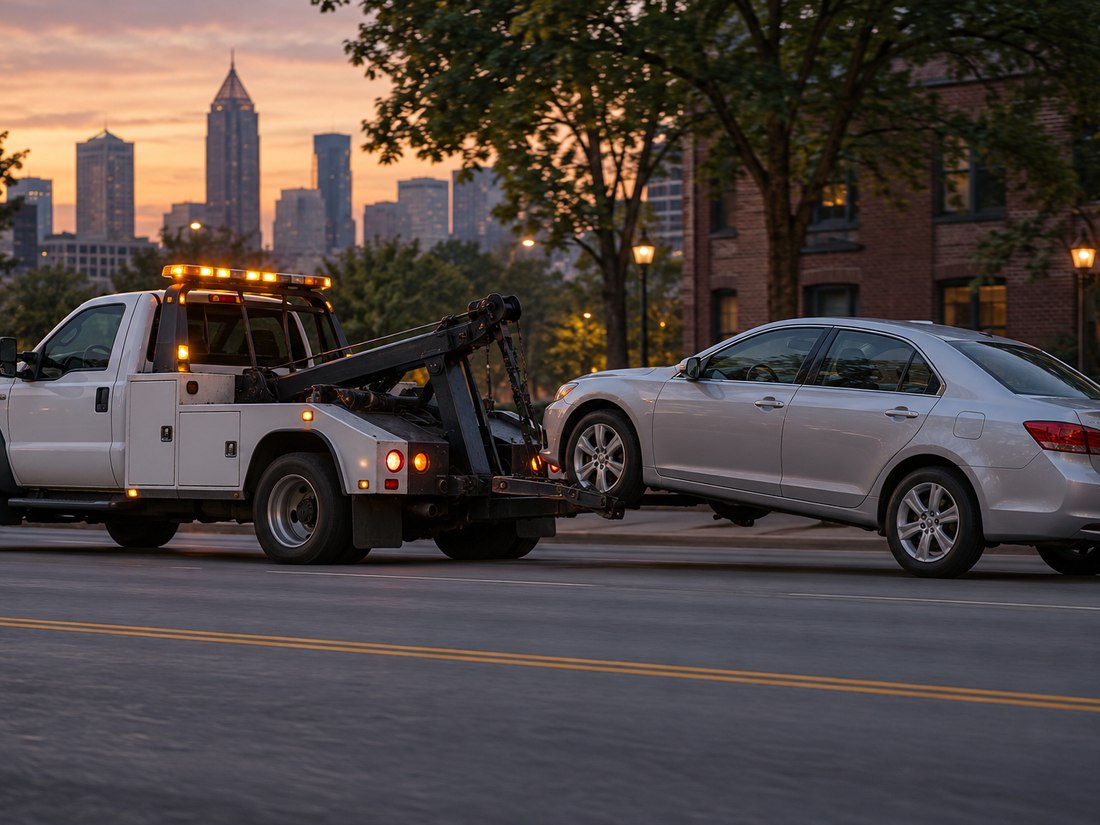
City tows and private-lot tows follow different rules
Georgia's Abandoned Motor Vehicle Act, as the Department of Revenue (DOR) describes it, lets towing and storage firms remove a vehicle from public or private property at the request of a law enforcement officer or of the private property owner. Which one asked matters: the state fee caps on this page cover only tows a property owner requests.
A private-property tow is what Georgia calls nonconsensual towing: a property owner or its agent has a car removed without the prior consent of the car's owner or driver. The Georgia Department of Public Safety (DPS) regulates these tows statewide, with maximum fees, sign rules and release rules. DPS Rule 570-38-7-.15 bars towing without a contract signed by the property owner and a request made on the day of the tow that identifies the vehicle.
A city or police tow is one an officer requests. The towing pages of the City of Atlanta and the Atlanta Police Department could not be read for this guide, so this page states no reasons, lots or fees for police tows. If police had your car towed, start with the Atlanta Police Department.
Source: Georgia DOR: Abandoned vehicles; DPS Rule 570-38-7-.15: Requests for nonconsensual towing; Atlanta Police Department.
Finding the car: the posted sign names the company and the lot
For a private-property tow, the answer is posted where you parked. DPS Rule 570-38-7-.14 requires signs within 50 feet of each designated entrance to the parking area, or as close as the ground allows, at least 12 by 18 inches. Each sign must show a tow warning, the towing company's name, address and phone number, the impound lot where towed cars are picked up, the towing and daily storage fees, the hours and the payment methods. Photograph the sign. It records what the company said it would charge.
The same rule bars moving a car from private property that lacked compliant signs at the time of the tow and for at least one full day before. That bar does not apply to residential property with four or fewer units.
The firm also has to reach you. DOR states: "Towing and storage firms in Georgia are required by law to notify vehicle owners, lienholders, and security interest holders when a motor vehicle has been towed and impounded." Firms can request owner contact information on Form MV-603 at a county tag office or at DOR's Motor Vehicle Division on Welcome All Road in Atlanta, so keep the address on your registration current.
Source: DPS Rule 570-38-7-.14: Sign specifications; Georgia DOR: Abandoned vehicles; Georgia DOR: Form MV-603.
What a private-lot tow can cost under Georgia's tariff
DPS Maximum Rate Tariff No. 5, in effect since June 17, 2024, sets ceilings, not fixed prices. Amounts are as of that tariff, read in October 2026. Firms may charge less, and a city may require lower maximums inside its limits. This guide could not confirm whether Atlanta has, so ask the firm which rate it uses. For a vehicle rated 10,000 pounds or less, the ceilings are:
- Removal: up to $228.
- Storage: no charge for the first 24-hour period after the car leaves the property or for any day the lot is closed and you cannot claim it, then up to $33 a day. Electric vehicles: up to $60 a day, or $100 if damaged and needing an isolation barrier.
- Notification fees: up to $26 if the firm notifies local police in writing within the first 24-hour period, and up to $65 after the first 72 hours, $91 in total at most.
- After-hours release outside the firm's posted hours: up to $65.
Worked example, built only from the tariff's maximums: a sedan towed from a shopping-center lot is collected four days later, during posted hours, from a lot open every day. The first 24-hour period is free, so three days are billable. The most the firm may charge is $228 for removal, 3 x $33 = $99 for storage and $91 in notification fees, since the car stayed past 72 hours: $418 in all. Check each line of your bill against the tariff before you pay.
Source: DPS Maximum Rate Tariff No. 5 (PDF); DPS: Tariff No. 5 announcement.
If you reach the tow truck before it leaves
DPS Rule 570-38-7-.16 covers the moment you find a wrecker at your car. If the car is not yet hooked up or loaded, and you produce the key and move it right away, the driver may not tow it or charge you anything.
If it is hooked or loaded but has not left the property, the driver still must let it go once you produce the key and agree to move it at once. The only charge allowed then is the operator's fee, capped by the tariff at $130 for a vehicle rated 19,999 pounds or less. Once the truck leaves the property, the full tariff applies.
Source: DPS Rule 570-38-7-.16: Vehicle not towed when the operator returns; DPS Maximum Rate Tariff No. 5 (PDF).
What to bring to the impound lot
DPS Rule 570-38-7-.18 lists what the lot can ask of you after a private-property tow:
- A valid driver's license.
- A key that starts the car, or another way to show you can start and drive it.
- Proof you own the car or may possess it, such as the Georgia title, a current registration card, a bill of sale, or a lease or rental contract.
- Payment of the towing and storage charges the rules allow.
If the car does not run, call the lot first and ask what it accepts in place of starting it.
On payment, the tariff says: "Payment may be made by cash, money order, certified check or cashier's check." The rule adds travelers checks and leaves the choice to you. A lot may take cards but may not add a fee for them.
Rule 570-38-7-.17 requires an attendant on site during normal business hours five days a week plus at least four hours on a sixth, and one reachable by phone at any hour who can come and release the car. You get a signed receipt listing each charge (Rule 570-38-7-.19).
Source: DPS Rule 570-38-7-.18: Release of towed vehicle; payment; DPS Rule 570-38-7-.17: Attendant to release towed vehicles; DPS Rule 570-38-7-.19: Receipt requirement; DPS Maximum Rate Tariff No. 5 (PDF).
What happens to a car nobody claims
The tariff marks a turning point: "After 30 days, the process outlined in Chapter 11 of Title 40 of the Official Code of Georgia, related to abandoned motor vehicles, applies." Under that process, DOR explains, towing and storage firms, repair shops and salvage dealers can obtain a lien on an unclaimed vehicle by notifying every owner, lienholder and security interest holder.
If the firm sells the car at a public sale under a court order, it satisfies its lien from the proceeds and must send the rest to DOR within 15 business days, less up to $120 for advertising and $200 for holding the sale. A person with a property interest in the vehicle "may make a claim to the Department within six months of the sale." DOR posts a list of these sales by owner name and VIN.
Source: DPS Maximum Rate Tariff No. 5 (PDF); Georgia DOR: Abandoned vehicles; Georgia DOR: Remitting and claiming excess funds; Georgia DOR: Sales with excess funds.
Selling a car that is sitting in a tow lot
None of the Georgia or Atlanta pages used here describe selling a car while an impound lot holds it, and the release rule asks for a license, a key, proof of ownership and payment from the person collecting the car. So the order is: get it released, then sell it.
Each billable day can add up to $33 for a standard car, so waiting costs money. Once the car is home, the partner buyer can make an instant online offer. The buyer says it arranges and covers the cost of pickup at a time that suits you, and that cars that do not run can still get an offer. See how the offer works. If the title is not in your name or a lender is on it, read title problems first.
Source: DPS Rule 570-38-7-.18: Release of towed vehicle; payment; The buyer: selling and free pickup.
Atlanta towing questions
Can a parking lot in Atlanta tow my car without a sign?
Not under Georgia's DPS rules, with one exception. DPS Rule 570-38-7-.14 forbids a tow from private property unless compliant signs were posted when the car was towed and for at least a full day before. Residential property with four or fewer units is the exception.
Does an Atlanta tow lot have to take a credit card?
No. Under DPS Rule 570-38-7-.18, a firm that tows from private property must accept cash, travelers checks, money orders, certified checks or cashier's checks, whichever you choose. It may take debit or credit cards, but it may not charge an extra fee for them. Call ahead if you plan to pay by card.
Once the car is back in your hands
With the car released, read how the partner buyer's offer works, or selling a junk car in Atlanta if it is not worth fixing. To talk it through, call (943) 230-8677.
More on selling a car in Atlanta
- PaperworkHow an Atlanta seller signs a Georgia title, when DOR wants a T-7 bill of sale, the 2026 odometer rule, the buyer's 7-day titling step, TAVT and the plate.
- Emissions testWhich of metro Atlanta's 13 counties and which model years need an emissions test, what Georgia asks of a seller, and what to do when a car fails.
- Title problemsLost Georgia title, a lender still on it, an owner who died or two owners on the line: the DOR forms and fees an Atlanta seller needs first.
- Any conditionSelling an Atlanta car that won't start, took on flood water or lost its catalytic converter: Georgia's salvage test, the emissions check and the free tow.
- Junk carJunk car in Atlanta: the partner buyer, a Georgia scrap or parts dealer and what it must collect, the no-title MV-1SP statement, and your plate.
- Where to sellPrivate sale, dealer trade-in or instant offer in Atlanta: how a trade-in cuts Georgia's 7.0% TAVT and when a repair pays.